
Core Web Vitals and Site Speed: The Decisive Factor for Online Success
Discover why site speed and Core Web Vitals are crucial for your business. Learn how to optimize them to attract more clients and improve your search rankings.
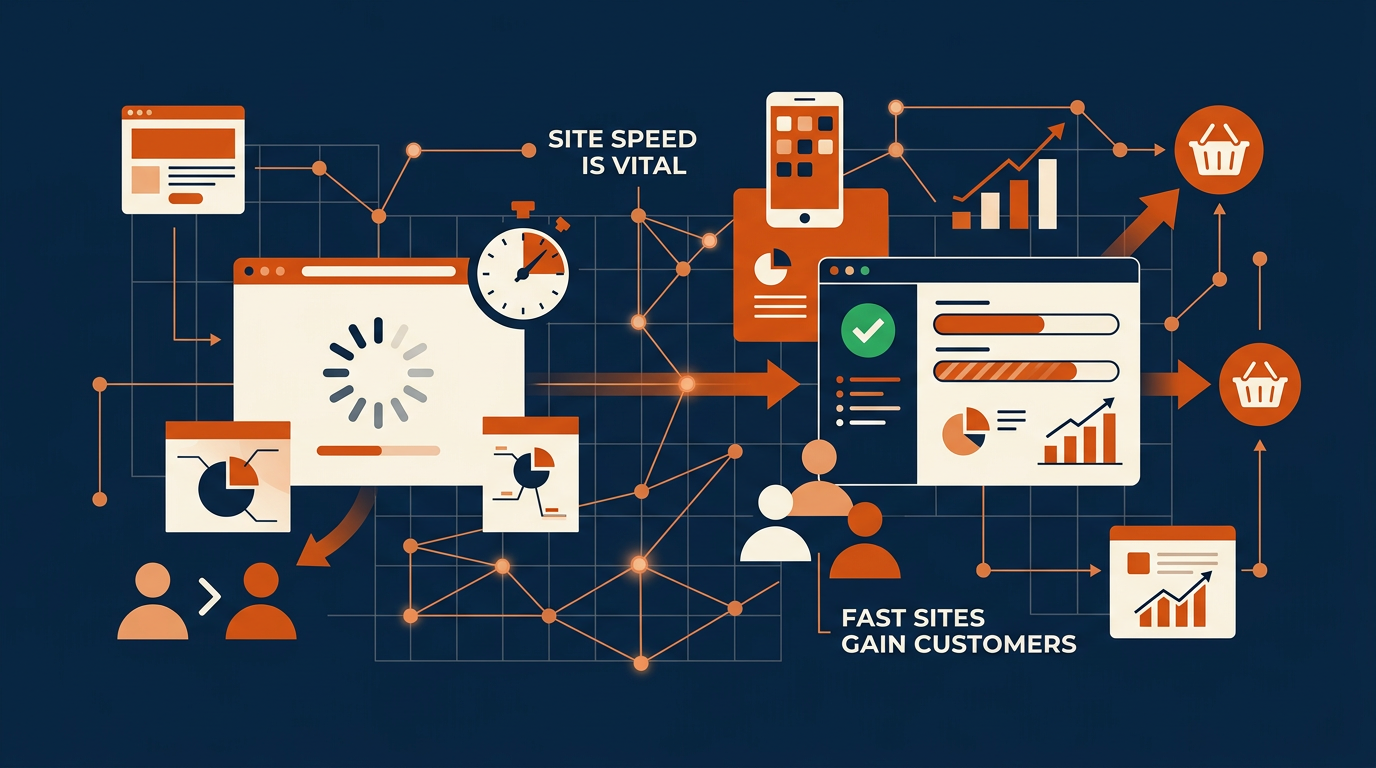
In today's fast-paced digital world, a website's loading speed is no longer an option, but a fundamental necessity. A slow website not only frustrates users but directly harms your search engine rankings and, consequently, your business. The Core Web Vitals, introduced by Google, have made performance a pillar of SEO and user experience (UX). At Connect & Create, a Swiss web agency specializing in supporting SMEs in Ticino and throughout Switzerland, we deeply understand the impact of these factors. This article will guide you through the importance of site speed, Core Web Vitals, and how to optimize them to attract and retain your clients.
The Impact of Slowness: More Than Just an Annoyance
Imagine searching for a product or service and encountering a website that takes agonizing seconds to load. Frustration is immediate, and the temptation to click the 'back' button is almost irresistible. You are not alone in this experience. Studies show that most users abandon a site if it doesn't load within a few seconds. This translates to lost potential customers, lower conversions, and significant reputational damage.
Shocking Site Speed Statistics:
- Over 50% of users expect a website to load in 2 seconds or less.
- A 1-second delay in page load time can reduce conversions by up to 7%. For an e-commerce business with an annual turnover of CHF 100,000, this could mean a loss of CHF 7,000.
- 70% of consumers consider page speed an important factor in the online shopping experience.
- 79% of visitors who are dissatisfied with a site's performance are less likely to revisit it.
These numbers are eloquent. For Swiss SMEs, where competition is high and customer trust is paramount, ignoring site speed means surrendering a valuable competitive advantage to your rivals.
What Are Core Web Vitals?
Core Web Vitals are a set of standardized metrics from Google, designed to measure user experience in terms of loading speed, interactivity, and visual stability. Google uses them as a ranking signal, meaning a site optimized for Core Web Vitals is more likely to rank better in search results. The three main metrics are:
1. Largest Contentful Paint (LCP): Measures perceived loading speed.
LCP measures the time it takes for the largest content element visible within the viewport (the visible screen area without scrolling) to load. This element is usually an image or a block of text.
- Target: Less than 2.5 seconds.
- Why it matters: A high LCP indicates that the main content of your site is taking too long to load, frustrating the user.
2. First Input Delay (FID): Measures interactivity.
FID measures the time elapsed between the user's first interaction with the page (e.g., clicking a link, tapping a button) and the moment the browser is actually able to respond to that interaction.
- Target: Less than 100 milliseconds.
- Why it matters: A high FID means your site is slow to respond to user actions, making the experience confusing and frustrating. Imagine clicking a button and having to wait several seconds to see an effect – that's a high FID.
3. Cumulative Layout Shift (CLS): Measures visual stability.
CLS measures the unexpected shifting of visual elements on the page during loading. For example, when text or an image 'jumps' unexpectedly while you are trying to read, causing the cursor position to change.
- Target: Less than 0.1.
- Why it matters: A high CLS makes the user experience chaotic and difficult. It can lead to accidental clicks on the wrong elements or losing your train of thought while reading.
How to Optimize Core Web Vitals for Your SME's Success
Optimizing Core Web Vitals requires a strategic and technical approach. At Connect & Create, we handle these optimizations as part of our comprehensive web development and SEO services, ensuring your site is not only fast but also performs well and keeps up with the demands of Google and users.
Optimizing LCP (Largest Contentful Paint):
- Optimize images: Compress images without compromising quality, use modern formats like WebP, and implement lazy-loading for images that are not immediately visible.
- Reduce server response times: Performant hosting is crucial. You may need to upgrade your hosting plan or optimize your site's backend.
- Eliminate render-blocking JavaScript and CSS: Ensure these critical files are loaded efficiently to avoid delaying the rendering of main content.
Optimizing FID (First Input Delay):
- Break up long JavaScript tasks: Split time-consuming JavaScript processes into smaller, manageable chunks to allow the browser to respond more quickly to user input.
- Reduce JavaScript execution time: Analyze and refactor your JavaScript code to make it more efficient.
- Use a web worker: Offload computationally intensive tasks to a background thread so they don't block the main thread.
Optimizing CLS (Cumulative Layout Shift):
- Specify dimensions for images and video elements: Always include width and height attributes for media elements to reserve space before they load.
- Avoid inserting content dynamically above existing content: This is a common cause of layout shifts.
- Use CSS transforms for animations: Animations performed using CSS transforms are generally more performant and less likely to cause layout shifts.
Tools to Measure and Monitor Core Web Vitals
Understanding your website's performance is the first step towards improvement. Google provides excellent free tools to help you:
- PageSpeed Insights: Analyzes your page's performance on both mobile and desktop devices and provides specific recommendations for improvement, including Core Web Vitals metrics.
- Google Search Console: Offers a dedicated Core Web Vitals report, showing how your pages perform in real-world user scenarios (field data) and highlighting any errors.
- Lighthouse: An open-source, automated tool for improving the quality of web pages. It can be run from Chrome DevTools or as a Node module.
Regularly checking these tools will give you a clear picture of your site's health and guide your optimization efforts. For Swiss businesses, ensuring optimal performance can mean the difference between a lead converting or a potential client bouncing to a competitor.
Frequently Asked Questions (FAQ)
What is the cost of optimizing Core Web Vitals?
The cost can vary significantly depending on the current state of your website and the complexity of the issues. Minor optimizations might be relatively inexpensive, while significant code refactoring or infrastructure upgrades could represent a more substantial investment. We recommend a personalized analysis. Explore our pricing for a transparent overview of our service costs.
How long does it take to improve Core Web Vitals?
The timeline depends on the severity of the problems. Simple fixes can be implemented within days, while complex issues might take weeks or even months to resolve fully. Consistent monitoring and iterative improvements are key.
Can I improve Core Web Vitals myself?
If you have technical expertise in web development and SEO, you might be able to address some issues. However, deep technical knowledge and experience are often required to tackle performance bottlenecks effectively. For most businesses, partnering with experts like Connect & Create is the most efficient route.
Are Core Web Vitals the only factor for SEO?
No, Core Web Vitals are an important ranking factor, but they are part of a broader SEO strategy that includes content quality, mobile-friendliness, security (HTTPS), and relevant backlinks. However, excellent Core Web Vitals performance can significantly boost your rankings and user engagement.
Conclusion: Invest in Speed, Invest in Your Future
In the competitive Swiss market, a slow website is a silent business killer. Core Web Vitals are not just technical jargon; they are tangible measures of user satisfaction and critical signals for search engines. By prioritizing site speed and optimizing these key metrics, you enhance user experience, improve your search engine visibility, and ultimately drive more conversions and revenue. Don't let your website's performance hold your business back. Take the step towards a faster, more effective online presence.
Ready to transform your website's performance and attract more clients? Contact Connect & Create today for a free, no-obligation quote and discover how our expert web solutions can boost your online success. Get your free quote now!