
From Excel to Custom ERP: A Practical Guide for Ticino SMEs
Stop losing money in spreadsheets. Learn how Ticino SMEs can digitize operations with a custom ERP, realistic CHF budgets, and a clear roadmap for scalability.
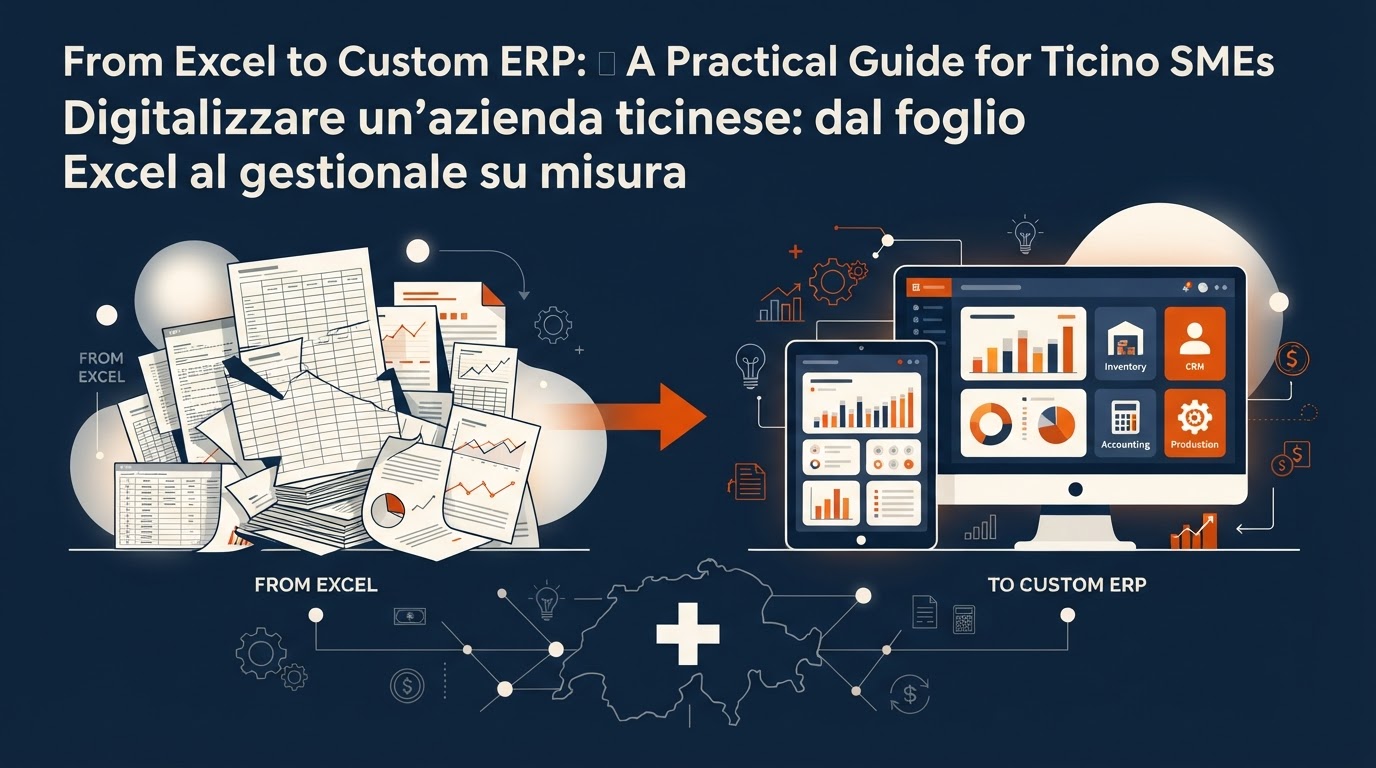
For decades, the heartbeat of many small and medium-sized enterprises (SMEs) in Ticino has been a meticulously maintained Excel file. It is familiar, flexible, and accessible. However, as your business grows, that "digital brain" becomes a bottleneck: fragmented data, manual errors, an inability to scale, and a strategic vision obscured by administrative burdens. Digitalization does not mean simply swapping one software for another; it means evolving your operational model to remain competitive in the modern market.
In this article, we analyze the concrete path from artisanal data management to a custom-built ERP system, structured specifically for the needs of the Ticino and Swiss entrepreneurial fabric. This is not abstract theory, but an operational roadmap with realistic cost estimates in Swiss Francs (CHF).
1. The Starting Point: Why Excel Is No Longer Enough
The transition toward advanced digitalization often stems from specific pain points. If you recognize these situations, it is time to act:
- Siloed Data: Sales data is in one file, production data in another, and accounting on a third piece of software that does not communicate with the others.
- Human Error: Manual repetition of data leads to duplications or typos that compromise billing and inventory accuracy.
- Lack of Real-Time Visibility: The CEO must wait until the end of the month to have a clear picture of profitability, making timely course corrections impossible.
Staying on Excel means accepting an artificial growth limit. An integrated system allows you to automate workflows, freeing up precious time for value-added activities such as commercial development and innovation. To understand how we approach these challenges, you can explore our services tailored for business efficiency.
2. The Digitalization Phases: A Step-by-Step Roadmap
Building a digital ecosystem does not happen overnight. Here are the fundamental steps to ensure success and a positive Return on Investment (ROI).
Phase 1: Audit and Process Mapping
Before writing a single line of code or purchasing software, you must understand what you do today. In this phase, all current workflows are mapped. Bottlenecks and redundancies are identified. For a manufacturing company in Lugano, it might emerge that a purchase order is entered manually three times: in the email to the supplier, in the internal register, and then in the accounting software. The goal is to eliminate at least two of these steps.
Phase 2: Technology Choice: Best-of-Breed vs. Complete Suite
There are two main approaches: 1. Complete Suite (ERP): One software manages everything (invoices, warehouse, HR). Ideal if you seek simplicity in single-system management. 2. Best-of-the-Best + Integration: You use the best software for each specific function (e.g., a leading CRM for sales, a specific one for production) linked together via APIs. This option offers greater flexibility and customization, typically preferred by innovative SMEs who want to maintain control over operational details.
Phase 3: Custom Development or Configuration
This is where an agency comes in. Unlike large multinationals, Ticino SMEs often have specific market niches. A generic management system might not handle the peculiarities of your supply chain. On-demand development ensures that the software works for you, and not the other way around. We specialize in creating solutions that fit your unique business logic, avoiding the "one-size-fits-all" trap.
Phase 4: Training and Change Management
The number one failure in digitalization is not technological, but human. The team must feel part of the process. Training should not be a boring two-day course, but practical accompaniment day-by-day during the first weeks of use. Creating internal video guides and rapid support channels is essential to lower resistance to change. Proper adoption is key to realizing the benefits of your investment.
3. Realistic Budgets in CHF: What to Expect?
One of the main obstacles is the perception of cost. In Switzerland, prices vary based on complexity and localization. Here is a realistic estimate for an average SME in Ticino:
- Initial Audit and Consulting: 2,000 - 5,000 CHF. Includes process analysis and strategy definition.
- Basic Development/Configuration: 15,000 - 40,000 CHF. Depends on the number of modules (CRM, Billing, Warehouse) and integration complexity.
- Complex API Integrations: 5,000 - 15,000 CHF. If you need to connect the new management system with legacy systems or specific e-commerce platforms.
- Training and Onboarding: 3,000 - 8,000 CHF. Includes hands-on sessions and documentation.
It is also important to consider recurring costs: hosting, monthly software licenses, and annual maintenance (approximately 15-20% of the initial development cost). However, the ROI is usually achieved within 12-18 months thanks to the savings in man-hours dedicated to repetitive administrative tasks. For a detailed breakdown of our pricing models, visit our pricing page.
4. Common Mistakes to Avoid
Based on our experience with clients in Lugano, Zurich, and across the Confederation, here are the most frequent errors:
- Over-engineering: Wanting a system that does everything immediately. It is better to start with a Minimum Viable Product (MVP) and add features later.
- Ignoring Data Quality: If existing data is dirty, the new system will only process errors more efficiently. Cleaning data before migration is crucial.
- Underestimating Change Management: Assuming employees will adapt automatically. Without strong leadership and communication, even the best software will fail.
5. The Long-Term Value of Digitalization
Digitalization is not a project with an end date; it is a continuous evolution. Once your core processes are digitized, you gain access to real-time analytics, predictive insights, and seamless collaboration. For a Ticino SME, this means being able to compete with larger international players by leveraging agility and precise data-driven decisions.
Consider the tangible benefits:
- Faster Decision Making: Access to live dashboards allows for immediate adjustments to pricing or stock levels.
- Improved Customer Experience: Integrated systems provide a 360-degree view of the customer, enabling personalized service.
- Scalability: As you grow, the system grows with you, without requiring a complete overhaul.
Frequently Asked Questions
How long does it take to implement a custom ERP?
Typically, between 3 to 6 months for an average SME, depending on the complexity of integrations and the readiness of the internal team. Smaller modules can be deployed faster.
Is it possible to migrate data from Excel directly?
Yes, but it requires careful cleaning. Raw Excel data often contains inconsistencies. Our process includes a data cleansing phase to ensure high-quality input into the new system.
Can I integrate my existing tools instead of replacing them?
Absolutely. Using a "best-of-breed" approach allows you to keep specialized tools (like specific banking or inventory apps) while connecting them to a central hub via APIs.
Conclusion: Take Control of Your Digital Future
Moving from Excel to a custom management system is a strategic investment that pays off in efficiency, accuracy, and growth potential. For Ticino businesses, this step is no longer optional but necessary to thrive in a globalized economy. By following a structured roadmap and choosing partners who understand local nuances, you can transform your administrative burden into a competitive advantage.
Ready to stop managing chaos and start managing growth? Let's discuss your specific needs and create a tailored plan for your business.
Get a free, no-obligation consultation to evaluate your digitalization needs. Contact us today to schedule your session.