
New Swiss FADP & Website: What SMEs Really Need to Do Now
Navigate the new Swiss Data Protection Act (FADP) for your website. Practical steps, real CHF costs, and technical compliance for Swiss SMEs.
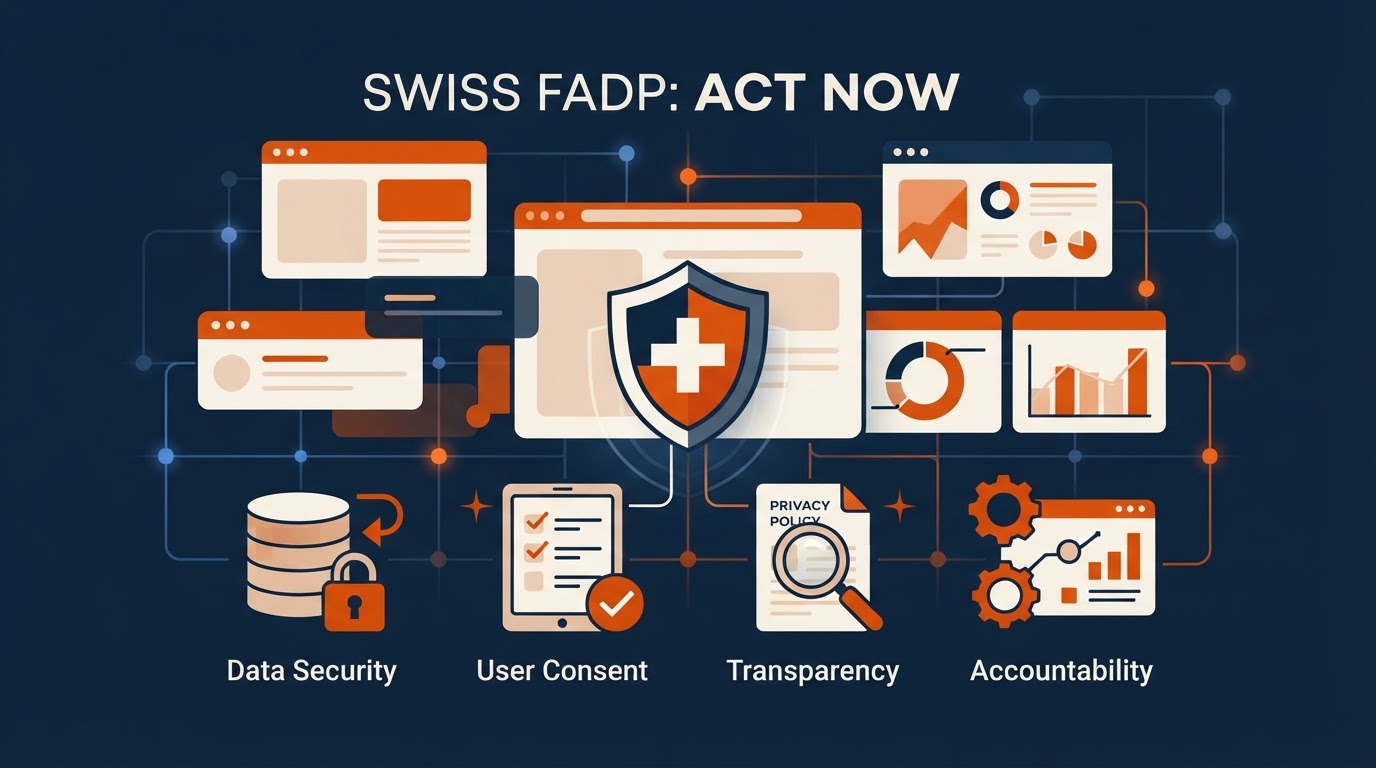
The revision of the Swiss Federal Act on Data Protection (FADP) is no longer a theoretical debate; it is the operational reality for every business in Switzerland. For Small and Medium Enterprises (SMEs), this legislative update represents a critical turning point. It is not merely about updating legal text, but fundamentally rethinking how your website collects, processes, and protects user information.
Many entrepreneurs fear that compliance requires massive investments or operational paralysis. The truth is different. With a targeted strategy, you can achieve full compliance without sacrificing user experience or digital competitiveness. This guide analyzes what is truly necessary to bring your online presence up to standard, distinguishing between actual legal obligations and media noise.
1. What has actually changed under the new FADP?
The core of the new regulation lies in the principle of transparency and the strengthening of data subject rights. Unlike the past, where privacy was often hidden in lengthy, incomprehensible clauses, the law now demands absolute clarity. The data controller must demonstrate that appropriate technical and organizational measures have been adopted to protect personal data.
For a corporate website, this means that every contact form, analytics cookie, and newsletter subscription must have a clear legal basis. The goal is not to scare the user, but to build trust. A compliant site conveys professionalism, a decisive factor in B2B sales across Ticino and the entire Confederation.
Applying the transparency principle to the web
It is no longer sufficient to include a generic link to "Terms and Conditions." You must explicitly specify:
- What data is collected (name, email, IP address, etc.).
- For what purpose (e.g., quote management, newsletter dispatch).
- How long the data is retained.
- Who has access (external providers, cloud hosting).
2. The 5 Technical Pillars for Your Website
Complying with the new FADP requires concrete interventions on your digital infrastructure. Here are the critical areas to verify immediately:
A. Cookie Banners and Active Consent
The old practice of "scrolling" or implicit consent is no longer valid. Explicit, free, and informed consent is required before any tracking scripts (Google Analytics, Facebook Pixel, etc.) are loaded. Using reliable plugins that block scripts until acceptance is accepted is fundamental. This ensures compliance and improves brand perception among demanding clients.
B. Secure Contact Forms
Every time a potential client fills out a form, you are processing personal data. It is mandatory to insert a specific privacy declaration next to the submit button. For example: "By submitting this form, you consent to the processing of your data for quote requests, according to our Privacy Policy." Additionally, ensure data transmission always occurs via HTTPS (active SSL certificate).
C. Data Retention Policies
The law imposes the principle of limitation of storage. You cannot keep lead data for years if it is no longer necessary. Establish an internal policy: for instance, delete or anonymize contact data from non-converting leads after 12-24 months. Documenting this procedure demonstrates good faith in case of an audit.
D. User Rights Facilitation
Visitors have the right to access, rectify, delete, or object to the processing of their data. Your site must facilitate these requests. Inserting a dedicated privacy email (e.g., privacy@yourdomain.ch) and responding within 30 days is a strict legal obligation.
E. Sub-processors and Cloud Services
If you use external services for hosting, CRM, or marketing automation (such as Mailchimp or Salesforce), you must verify that they have Data Processing Agreements (DPA) compliant with the new FADP. Often these providers offer standard clauses, but it is the final controller's responsibility to ensure the chain of compliance.
3. Real Costs and Timelines for Compliance
A common doubt concerns the economic impact. Many believe compliance requires tens of thousands of francs. Let us analyze a realistic estimate for a Ticino-based SME with a showcase website and blog.
- Initial Audit and Data Flow Mapping: CHF 800 - 1,500. Identifying all data collection points.
- Legal Text Revision (Privacy Policy & Terms): CHF 500 - 1,000. Custom-drafted, not copied from generic templates.
- Technical Implementation (Cookie Banner, Forms, HTTPS): CHF 300 - 800. Depends on platform complexity (WordPress, Shopify, custom).
- Staff Training: CHF 200 - 500. Consultation hours to teach the team how to handle deletion requests.
Total estimated cost: between CHF 1,800 and CHF 3,800. This is a one-time investment, quickly amortized by reducing sanction risks and improving corporate reputation. Ignoring compliance, however, can lead to significant fines and image damage difficult to recover.
4. Common Mistakes to Avoid
In our daily work with companies, we often observe recurring issues that compromise compliance:
- Copying others' policies: Every company processes data differently. A generic policy does not reflect your specific practices and is legally vulnerable.
- Ignoring third-party tools: Assuming that because you use a popular plugin, you are automatically compliant. You remain responsible for configuration.
- Delayed responses: Failing to respond to user data requests within the statutory 30-day window can result in penalties from the Federal Data Protection and Information Commissioner (FDPIC).
5. Why Professional Support Matters
Navigating the legal nuances of the FADP while maintaining a high-performing website requires expertise. At Connect & Create, we help Swiss SMEs bridge the gap between legal requirements and technical execution. We do not just "check boxes"; we integrate compliance into your digital strategy to enhance trust and conversion rates.
Whether you need a complete website overhaul or a specific compliance audit, our team provides tailored solutions. You can explore our service offerings here or view our transparent pricing structures on our pricing page.
Frequently Asked Questions
Does the new FADP apply to me if I am based outside Switzerland?
If you target Swiss customers or process data of individuals located in Switzerland, the FADP applies to you, regardless of your physical location. Cross-border data transfers must also respect specific legal frameworks.
Do I need a DPO (Data Protection Officer)?
Not necessarily. Only organizations that are obliged by law to publish their data protection provisions or whose activities require continuous monitoring of data subjects must appoint a DPO. Most SMEs do not fall into this category but still need to designate a contact person for data protection matters.
Can I use Google Analytics under the new law?
Yes, but with strict conditions. You must ensure that no personal data is transferred to the US unless adequate safeguards (like Standard Contractual Clauses) are in place. Many Swiss companies now prefer local analytics solutions or fully anonymized data to minimize risk.
What happens if I get fined?
The FDPIC can impose administrative fines of up to CHF 250,000 for intentional violations. However, the focus is usually on corrective measures. Demonstrating proactive compliance efforts significantly mitigates potential penalties.
Conclusion: Turn Compliance into a Competitive Advantage
The new FADP is not a burden; it is an opportunity to differentiate yourself. In a market where data breaches are increasingly common, transparency builds loyalty. By investing in proper compliance now, you protect your business from future risks and signal to your clients that you value their privacy.
Do not wait for a regulatory warning to act. Start with a simple audit of your current data flows and update your consent mechanisms. If you need expert guidance to navigate this transition smoothly, we are here to help.
Ready to secure your online presence? Contact us today for a free, no-obligation consultation on your data protection needs. Get in touch here.