Website Redesign: 5 Clear Signs It’s Time to Refresh Your Swiss Business Site
Is your website costing you leads? Discover 5 concrete signs it's time for a redesign, with real CHF impact examples for Swiss SMEs.
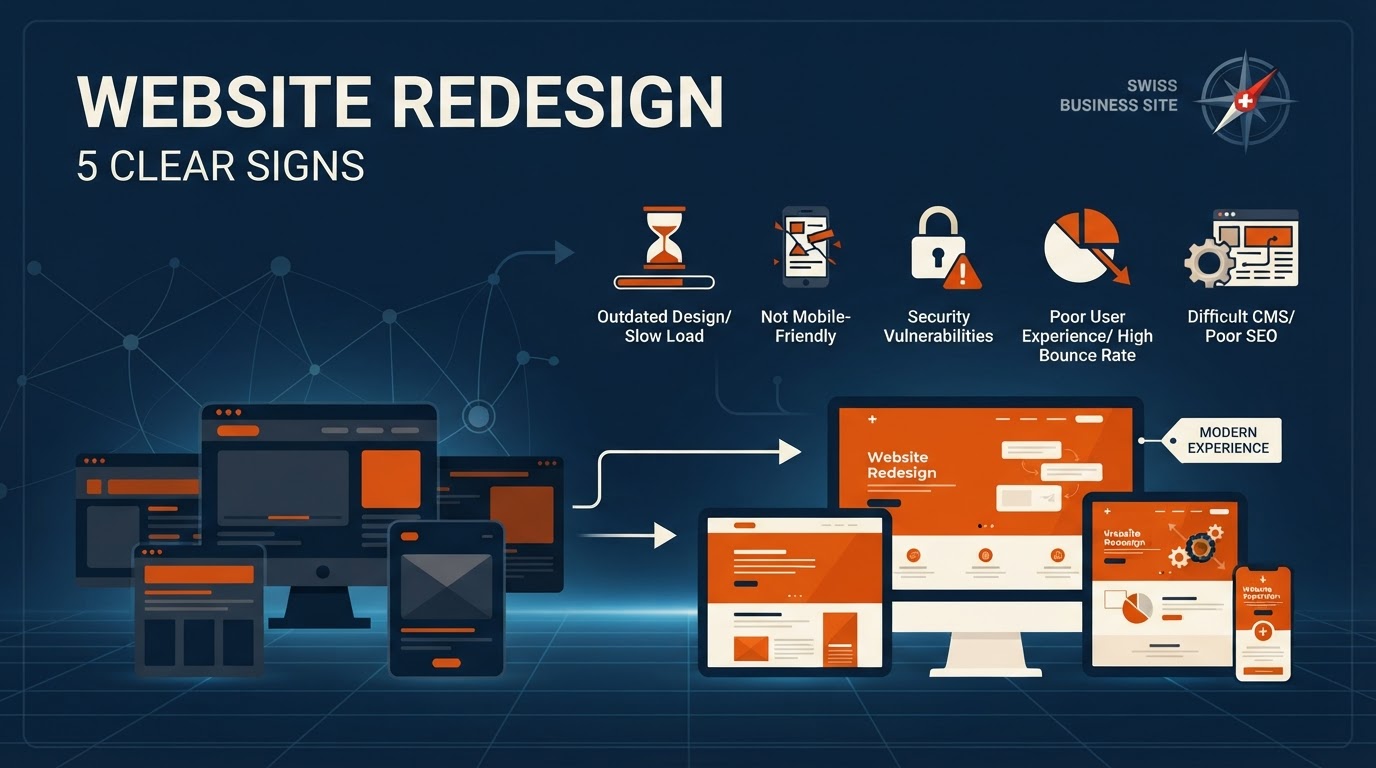
A website is not a static product but a dynamic asset that must evolve alongside the market. For many SMEs in Switzerland, the website remains the primary storefront and the first point of contact with potential clients. However, maintaining an obsolete design or inefficient technical structure incurs significant hidden costs: lost leads, brand reputation damage, and operational inefficiencies.
Refreshing your site (often called a "redesign") is not just an aesthetic issue. It is a precise business strategy to improve user experience (UX), optimize Google positioning, and increase conversion rates. In this article, we analyze the concrete signals indicating that now is the time for intervention, supported by practical data and economic considerations.
1. The Design Is Not "Mobile-First": You Are Losing Traffic and Revenue
According to the latest Statista data, over 60% of global web traffic comes from mobile devices. If your site does not adapt perfectly to smartphone screens, you are essentially closing the door on a majority of your visitors. A non-responsive design forces users to zoom, scroll horizontally, and click on elements that are too small, generating immediate frustration.
The warning sign: When you visit your site from your phone and notice that menus are difficult to navigate or images cut off important text, you have an urgent problem.
Economic impact: Imagine having 1,000 monthly visits. If 60% arrive via mobile and you alienate 40% due to poor UX, you lose 240 potential contacts per month. Annually, considering an average B2B/B2C conversion rate between 1% and 3%, this can translate into thousands of CHF in lost revenue every year. A modern redesign adopts a mobile-first approach, guaranteeing speed and readability everywhere.
2. Loading Times Exceeding 3 Seconds
Online patience is nearly non-existent. Studies by Google show that bounce probability rises drastically if a page takes more than 3 seconds to load. Each additional second of delay reduces conversions by up to 7%. For a Swiss business site, where competition is high and alternatives are a click away, slowness is a silent killer.
The warning sign: You use free tools like Google PageSpeed Insights or GTmetrix and get scores below 50/100 for the mobile version, or you notice images appearing gradually in an unnatural way.
Investment vs. Return: Optimizing images, leveraging caching, and updating legacy code require specific technical skills. Often, instead of simply "redoing" the site, it is necessary to rethink its architecture. A fast site not only retains users but is rewarded by Google with better organic search positions, reducing the need to spend excessively on paid advertising.
3. Confused Information Architecture and Complex Navigation
Many sites developed years ago suffer from excessive structural complexity. Too many menu items, orphan pages (poorly linked or unlinked), and non-linear user paths create friction. The goal of a business site is to guide the visitor toward a clear action: requesting a quote, calling, or downloading a brochure.
The warning sign: You frequently receive questions from clients saying "I couldn't find that page" or "I didn't understand how the contact form worked." Additionally, if content is scattered across too many sub-pages without a clear hierarchical logic.
Concrete example: A construction company in Lugano restructured its website by simplifying the navigation from 8 to 4 main sections. In the first quarter after launch, online quote requests increased by 25%, simply because the path was shorter and more intuitive.
4. Lack of HTTPS Security and Regular Updates
2024 imposes rigorous security standards. Modern browsers (Chrome, Safari, Edge) clearly display insecure sites with red "Not Secure" warnings, immediately discouraging users. Furthermore, CMS platforms like WordPress require constant updates to plugins and core to close security vulnerabilities. Maintaining an outdated site means exposing the company to hacking risks, data loss, and irreparable image damage.
The warning sign: The SSL certificate has expired, the padlock icon does not appear in the address bar, or your current provider does not provide regular maintenance reports.
Why it is critical: Beyond user trust, Google actively penalizes insecure sites in rankings. Not having HTTPS is no longer a technically acceptable option for any serious professional activity.
5. Obsolete Content and Lack of SEO Strategy
A static site with texts written five years ago conveys the idea of a company frozen in time. Search engines reward content freshness, keyword relevance, and semantic structure. If your site is not optimized for local searches (e.g., "consulting services Zurich" or "plumber Ticino"), you will be invisible compared to competitors investing in their digital presence.
The warning sign: You rank on the first page only for your exact company name, but not for generic terms related to your services. Or, your blog or news section has not been updated for months.
How to Plan the Redesign Without Waste
Moving to a redesign should not be a blind expense. It requires a structured approach that aligns technical improvements with business goals. At Connect & Create, we help Swiss SMEs evaluate whether a full rebuild or a targeted optimization is the right choice based on their specific needs and budget.
We start by auditing the current technical performance, analyzing user behavior through heatmaps, and reviewing the competitive landscape in your specific sector. This ensures that every franc invested contributes directly to growth.
If you are unsure about the scope of work needed, reviewing our pricing structures can give you a clearer idea of the investment levels required for different types of projects, from simple refreshes to complete platform migrations.
Frequently Asked Questions
How much does a website redesign cost in Switzerland?
Costs vary significantly depending on complexity. A basic corporate site refresh might range from CHF 3,000 to CHF 8,000, while complex e-commerce or custom web applications can exceed CHF 20,000. We provide transparent quotes tailored to your specific requirements.
How long does a typical redesign take?
For most SME websites, the process takes between 4 to 8 weeks. This includes discovery, design, development, testing, and launch. Urgent projects may be accelerated, but quality assurance should never be compromised.
Can I update my site myself after the redesign?
Yes. We build all our sites on user-friendly CMS platforms (like WordPress) that allow you to easily update text, images, and news without needing coding knowledge. We also offer training sessions to ensure your team feels confident managing the new site.
Will a redesign affect my current SEO rankings?
It can, if done incorrectly. However, when planned properly, a redesign improves SEO by fixing technical errors, improving speed, and enhancing content structure. We implement strict redirect protocols to preserve your existing link equity during the transition.
Conclusion
Your website is often the most visited "room" in your business. If it feels cluttered, slow, or outdated, it sends a message to your clients that you are behind the times. Addressing these five signals is not just about technology; it is about respecting your customers' time and expectations.
Don't wait for a crisis to act. Proactively refreshing your digital presence is one of the highest ROI investments a Swiss SME can make. Whether you need a quick fix or a comprehensive transformation, having a partner who understands the local market is crucial.
Ready to transform your outdated website into a lead-generating machine? Contact us today for a free, no-obligation consultation and discover how we can help your business grow.