
How to Write a Blog Post That Brings Clients: The 2026 SEO Guide for Swiss SMEs
Learn how to write blog posts that convert traffic into clients in 2026. A practical SEO guide for Swiss SMEs focusing on intent, structure, and ROI.
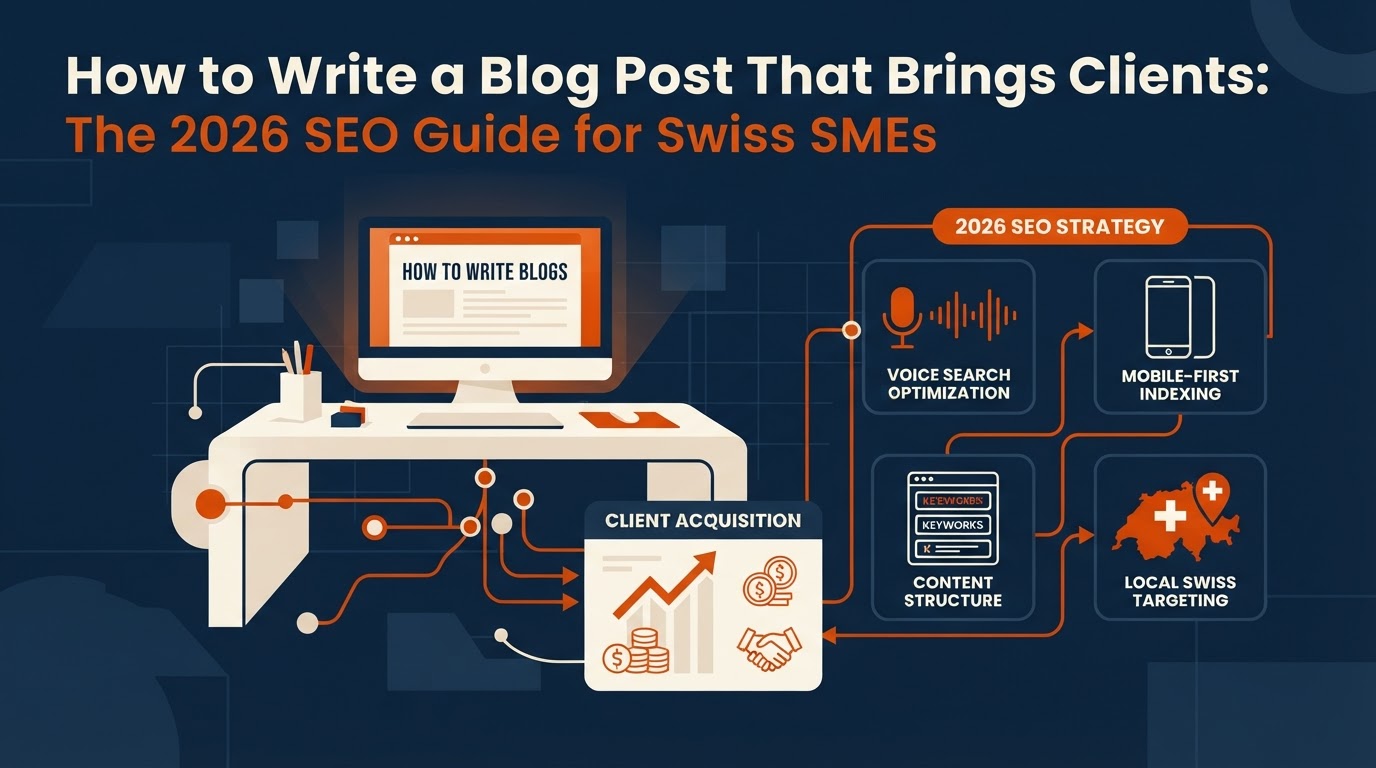
Content marketing is no longer just about visibility; it is about measurable conversion. In 2026, the digital landscape in Switzerland demands sophisticated strategies. Artificial intelligence has lowered entry barriers, making quality and authority (E-E-A-T) the only true differentiators. For Ticino and Swiss SMEs, publishing generic content means wasting budget. This article explains exactly how to write a blog post that brings real clients, turning readers into qualified prospects.
The Search Intent: The Heart of Your Strategy
Before writing a single word, you must understand why someone is searching for your solution. Google rewards content that perfectly satisfies user intent. It is not enough to be "well-positioned"; you must be relevant. There are three main intents:
- Informational: The user wants to learn something (e.g., "What is GDPR?").
- Commercial: The user is comparing solutions (e.g., "best accounting software for restaurants in Ticino").
- Transactional: The user is ready to buy (e.g., "web design quote Lugano").
To bring clients, you must focus primarily on commercial and transactional intents. An informational article attracts traffic, but a commercial one attracts wallets. The key is guiding the user from doubt to decision.
Winning Structure: H2, H3, and Readability
Your article's HTML structure must be logical for both search engines and human users. No one reads walls of text. Use a clear hierarchy with H2 and H3 tags.
1. The Title (H1): Clear Promise
The title must contain the main keyword and a value promise. Avoid vague wordplay. An effective example: "Complete Guide to Local SEO for Businesses in Lugano." It is specific, indicates geolocation, and promises utility.
2. Introduction: The Problem and Solution
In the first 100 words, address the reader's pain point and announce the solution. If you sell digital services, start by saying: "If your revenue is stagnant despite an excellent product, your digital message likely isn't reaching those who can pay." Then get straight to the point.
3. Body: Concrete Examples and Data
Google appreciates direct experience (the 'E' in Experience within E-E-A-T). Insert real case studies with CHF figures. Instead of saying "we increased sales," write: "Thanks to a targeted content strategy, a mechanical company in Bellinzona increased online quotes by 40% in three months, generating approximately 15,000 CHF extra in monthly revenue." Specificity builds trust.
On-Page SEO: Beyond Keywords
In 2026, on-page SEO is based on semantics and user experience. Here are the indispensable technical pillars:
- Compelling Meta Description: It must contain an implicit CTA. Do not exceed 155 characters.
- Short, Descriptive URLs: /blog/write-blog-posts-clients is better than /blog/?p=123.
- Strategic Internal Linking: Link your article to other relevant pages on your site. This distributes "link juice" and keeps the user in your ecosystem. For instance, if you discuss optimization, link to our pricing page.
- Loading Speed: Optimized images and clean code are fundamental for Core Web Vitals.
The Call to Action (CTA): Closing the Loop
An article without a clear CTA is like a shop without a cashier. Your goal is not just to make people read, but to make them act. Effective CTAs are specific and reduce friction.
Examples of powerful CTAs:
- Low Friction: "Download the free checklist for your website SEO audit."
- Medium Friction: "Book a 15-minute discovery call."
- High Friction: "Request a detailed quote for your project."
Remember to place the CTA after the most convincing paragraph, not just at the end of the page. Many users scroll quickly; seize the moment.
Geographical Differentiation: Ticino and Switzerland
SMEs operate in specific local contexts. A generic article "SEO for businesses" loses against an article "SEO for hotels on Lake Lugano" or "Digital Marketing for law firms in Zurich." Leverage localization to build immediate trust. Swiss clients prefer partners who understand the local cultural and linguistic context. If you also operate outside Ticino, create dedicated pages for cities like Zurich or Lugano to capture hyper-local search intents.
Frequently Asked Questions (FAQ)
How long should a blog post be to be effective?
There is no magic length, but recent studies indicate that content between 1,500 and 2,500 words tends to perform better for competitive terms, provided they are dense with useful information. Depth beats superficiality.
Can I use AI to write my articles?
Yes, but with caution. AI is excellent for brainstorming, structures, and initial drafts. However, to convert clients, you must add your human touch: expert opinions, company case studies, and brand voice. Google penalizes purely AI-generated content lacking added value.
How long does it take to see SEO results?
SEO is a medium-to-long-term investment. Usually, significant results appear after 3-6 months of consistency. Do not look at individual articles, but at the cumulative organic traffic trend. Patience and quality yield higher ROI than quick fixes.
Ready to implement these strategies? Stop guessing and start converting. Contact us today to discuss how we can help your business grow through strategic content.
Get a free consultation and discover how we can transform your blog into a client-generating machine. Contact us now.